
A renewal date lives in one account handler’s calendar, the handler goes on leave, and the client hears from a competitor first. Brokers buy an insurance broker management system to stop that, and the packaged systems on the 2026 list below all track renewals. The products differ in the business each one assumes: a retail agency placing cover with carriers, a health and benefits agency, an insurer building portals for its brokers, or a broker or MGA that holds delegated authority and issues policies itself.
What is an insurance broker management system?
An insurance broker management system is the system of record for a brokerage: every client, the policies placed for them with each carrier, the submissions and quotes that led there, and the work still open on the account. US vendors usually call the same category an agency management system (AMS). In daily use it covers these jobs:
- One client record with policies, claims, documents and correspondence, so whoever picks up the phone can answer.
- Submissions and quotes: risk details captured once, sent to several markets, and the terms compared side by side.
- Renewals and follow-ups as tasks with an owner and a date, rather than reminders in someone’s calendar.
- Documents such as quotes, certificates and cover notes generated from client data and stored against the record.
- Commissions: what each carrier owes, what has arrived, and the split by producer.
- Policy data downloaded from carriers instead of retyped, and a portal where clients see their cover and documents.
Broker management system or policy administration system?
A broker management system records business placed with someone else. A policy administration system (PAS) is where a policy is created: rated, issued, endorsed, renewed and billed. Insurers and MGAs run one. A broker needs it only when it holds delegated authority and binds cover on the insurer’s behalf; from then on, placement and policy administration work best on the same data, or the bordereaux owed to each capacity provider get assembled by hand from two systems. Our insurance software guide shows where each type of system sits in the policy lifecycle.
How to choose a broker management system: five questions
Feature lists in this category overlap heavily. These questions separate the products faster:
- Which lines do you write? Health, Medicare and group benefits agencies need consent, enrollment and compliance workflows that a P&C system does not have, and the reverse holds for certificates, loss runs and commercial lines rating.
- Do you hold, or plan to hold, binding authority? If so, the system has to issue and endorse policies and report bordereaux, not only record what a carrier issued.
- How does business reach your carriers? In the US, carrier downloads and rating integrations decide how much your team retypes. Outside the US, ask which carrier feeds exist and who builds the missing ones.
- How is it priced? On a per-seat price the bill grows with every hire; on a flat licence it does not depend on headcount. Two of the five vendors below publish prices.
- Can you take your data with you? Client records, policy history, documents and commission history should export in a usable form, or the next switch costs more than this one.
Best insurance broker management systems in 2026
We checked each product on its vendor’s own website on 2 October 2026. Two products have new names: NowCerts now sells its system as Momentum AMS, and Guidewire Digital is now sold as Guidewire Jutro. Figures quoted below are each vendor’s own.
Openkoda
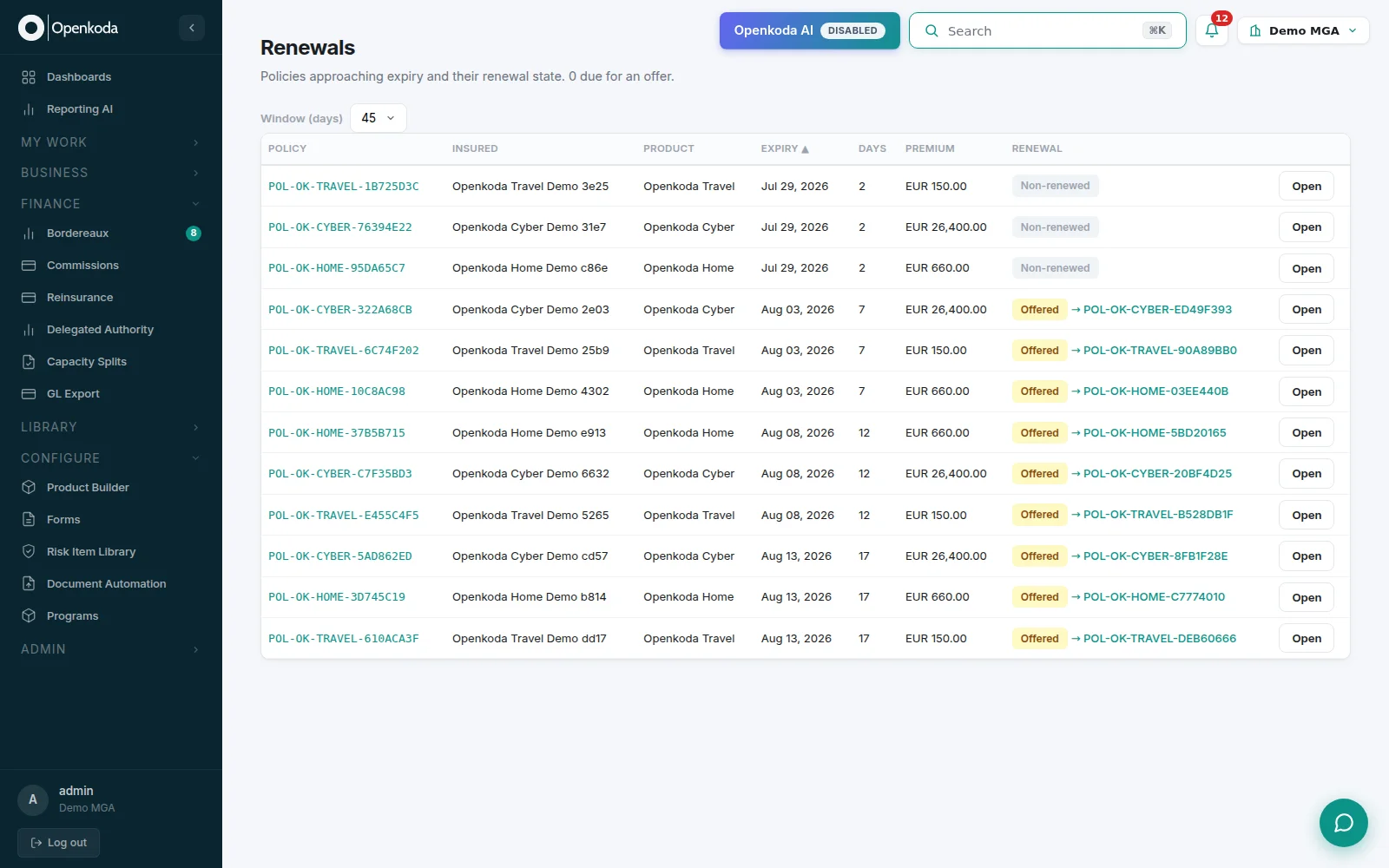
Openkoda is an insurance policy administration system with modules for brokers. It is built and licensed by our sister company of the same name; Stratoflow implements it. A broker uses it as a client 360 and a placement desk: submissions and quotes sent to several markets and compared, renewals and follow-ups as tracked tasks, documents generated from client data, commissions tracked across carriers, and a branded client portal. Where a broker holds delegated authority, the same platform runs full policy administration: issuing, endorsing and renewing policies, with bordereaux reporting to the capacity provider.
It is not a packaged agency management system, and openkoda.com says so in its own FAQ, which calls it “a configurable insurance platform, not a packaged CRM product”. Fields, workflows, document templates and pipelines are configuration, set up to match how the brokerage works, so it needs an implementation before go-live where a packaged AMS works on the first day. It runs fully managed on Openkoda Managed Cloud or on premise.
Key features
- Client 360: policies, submissions, claims, documents and correspondence on one record.
- Submissions and quotes captured once, sent to several markets and compared side by side.
- Renewals, chasers and new leads create their own tasks, each with an owner and a date.
- Document generation for quotes, policy summaries, certificates and cover notes, stored against the client.
- Commission tracking per carrier (owed, received, outstanding), split by producer.
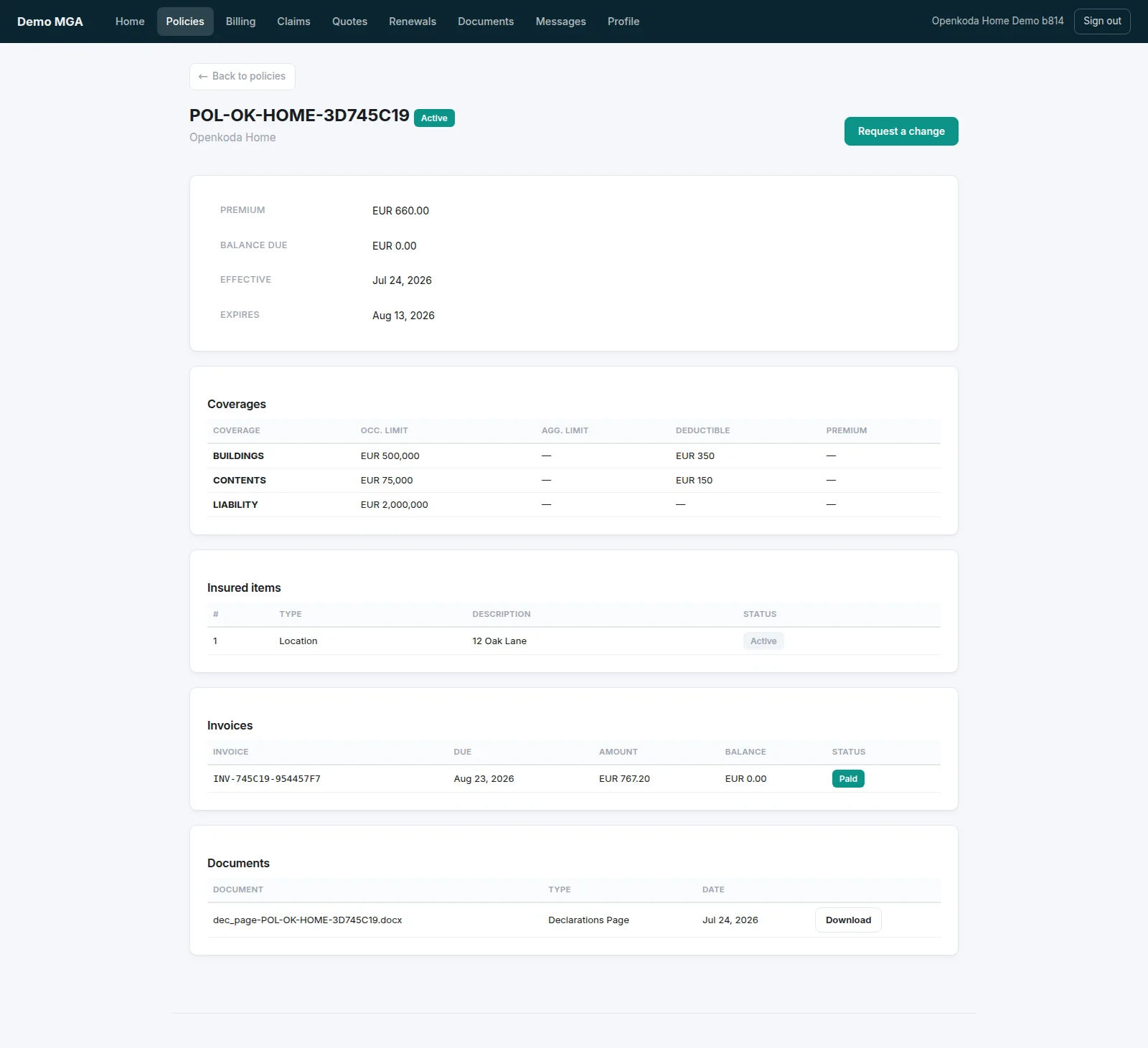
- A branded client portal where policyholders view cover, download documents, request changes and notify claims.
- Full policy administration under delegated authority, with versioned products and bordereaux reporting.
- Openkoda AI, a separate monthly subscription: Reporting AI answers questions about the book in plain English, and AI document reading pre-fills a case from PDFs and emails for a person to confirm.
Pros
- Placement and, where you hold authority, policy administration and bordereaux on one set of data.
- Published, flat pricing on an annual contract, with no per-seat, per-policy or percentage-of-premium fees (plans on openkoda.com).
- Configuration and data stay yours and export at any time, managed or on premise.
- ACORD-aligned data model, REST API, webhooks and a multi-tenant, multi-brand setup for groups and programs.
Cons
- Configuration comes before go-live: openkoda.com puts an implementation at weeks to a few months, depending on scope.
- Carrier feeds are custom integrations, scoped with you and billed on a time and materials basis.
- Client and broker portals and multi-organization support come with the Enterprise plan, and AI features are a separate subscription.
Best for
Brokers and MGAs that hold or plan to hold delegated authority, run several brands or programs, or work in ways a packaged AMS does not fit, and want placement and policy administration on the same platform.
Applied Epic
Applied Epic, from Applied Systems, is a cloud agency management system for mid-size and enterprise independent agencies, with P&C and benefits business in one browser-based system. Applied says 7 of the 10 largest insurance agencies have standardized on it, citing the Business Insurance Top 100.
In its July release, Applied added agency bill reconciliation to Applied Recon, which uses AI to extract and match carrier statements for a person to confirm.
Key features
- P&C and benefits in one system, with Epic Benefits workflows for plans, rates, eligibility, stop loss and TPA details.
- Prospecting, pipeline management, market access, and personal and commercial lines quoting and submissions.
- Insurance accounting and digital payments built in.
- Insurer connectivity through Ivans for submissions, servicing and policy data.
- Role-based dashboards, and workflow automation with data prefill and email summaries.
- Integration with a customer self-service portal and mobile app.
Pros
- Breadth: sales, servicing, accounting and benefits in one product.
- Carrier connectivity through Ivans for both personal and commercial lines.
- APIs, permissions and branch and group hierarchies for agencies that grow by acquisition.
Cons
- No published pricing.
- Applied aims it at mid-size and enterprise agencies; small agencies are not its stated audience.
- An agency-side system: it records policies that carriers issue rather than issuing them under delegated authority.
Best for
Mid-size and large US independent agencies writing P&C and benefits that want one system with deep carrier connectivity.
AgencyBloc AMS+
AMS+ is AgencyBloc’s agency management system for health, life, senior and group benefits agencies, from independent agents to IMOs and FMOs with downlines. It is sold as part of the AgencyBloc Plus Suite with Commissions+, Engage+ and Quote+. AgencyBloc says more than 6,500 agencies use its products.
Key features
- A CRM for health, senior and benefits business, with policy records linked to individuals, groups, agents and carriers.
- Compliance tools for Scope of Appointment, ACA Consent to Contact, ACA attestations and broker compensation.
- Agent management, including licence tracking, for uplines with downline agents.
- A built-in phone system, texting, email marketing and appointment scheduling.
- Commissions+ (a separate product) imports carrier data, finds missed commissions and produces agent statements.
Pros
- Workflows built around health and Medicare compliance rather than adapted from P&C.
- Agent hierarchies and payouts for GAs, IMOs and FMOs.
- AgencyBloc states that its products are HIPAA compliant and backed by a SOC 2 Type II report.
Cons
- Not built for P&C brokers.
- Commissions and quoting are separate products, and pricing is on request.
- No client self-service portal is listed on its site.
Best for
Health, Medicare, life and group benefits agencies, and the uplines (GAs, IMOs, FMOs) that manage downline agents.
Momentum AMS (formerly NowCerts)
NowCerts merged with Insurance Gig in 2023, and in 2024 the merged company rebranded as Momentum. Its agency management system is now Momentum AMS, the core of a platform it calls Momentum AMP. Momentum reports more than 1,600 agencies and over $10 billion of premium on the platform, and describes itself as the fourth-largest AMS provider in the US.
Key features
- Policy updates downloaded from more than 300 carrier databases, by Momentum’s count.
- Self-serve certificates: clients issue their own certificates of insurance.
- Agency and agent commission tracking, commission reconciliation, invoices and receipts.
- ACORD forms, a claims module for P&C agencies, more than 40 customizable reports and an insured portal.
- Add-ons for quoting and binding (Momentum Rate), workflow automation, statement scanning and a voice agent.
Pros
- Published pricing: from $119 a month for one user, $54 for each additional seat (Momentum pricing).
- No contracts, a free trial and complimentary onboarding; Momentum puts go-live at three to four weeks on average.
- An open API for integrations.
Cons
- Per-seat pricing grows with headcount, and rating, automation and voice are priced separately.
- An agency-side system: it records policies that carriers issue rather than issuing them.
Best for
Small and mid-size US independent agencies, P&C in particular, that want a published price, no contract and a fast start.
Guidewire Jutro
Guidewire no longer markets a product called Guidewire Digital. Its digital experience product in 2026 is Guidewire Jutro, a development platform that P&C insurers use to build web apps and portals for policyholders, agents, brokers, adjusters and vendors on top of Guidewire’s core applications.
It stays on this list because brokers meet it: when a carrier builds its broker portal on Jutro, that portal is where your account handlers quote and service that carrier’s business. A brokerage does not buy it, and it is no substitute for a system of record across all your carriers.
Key features
- A software development kit, open APIs and Guidewire’s Advanced Product Designer.
- A design system and component library that connects to Figma.
- Experience templates, such as quote and buy for agents selling homeowners and personal auto, and first notice of loss for policyholders.
- Micro frontends that embed in partner sites or Guidewire EnterpriseEngage apps.
Pros
- Native integration with Guidewire’s core applications, so a quote in the portal is processed straight through.
- One toolkit for portals for every user group an insurer serves.
Cons
- Sold to P&C insurers, not to brokers.
- A development platform: every portal is a build by the insurer’s developers or partners.
Best for
P&C insurers on Guidewire that want to give brokers and agents a quote-and-service portal. For a brokerage’s own system, look at the other four.
Independent agencies in 2026: AI use, hiring and policy gaps
The 2026 Agency Universe Study from the Big “I” (Independent Insurance Agents & Brokers of America) and Future One, released on 23 September 2026 with 1,376 respondents, counts about 37,000 independent agencies in the US. 46% of agencies report using AI, up from 15% in 2024, mostly for marketing content (49%), coverage form analysis (43%) and contract reviews (35%). Finding and screening job candidates is the top challenge (45%), and keeping up with AI comes second (43%).
The Big “I” Agents Council for Technology’s 2026 Tech Trends Report, published in February 2026, adds the gap: 8% of agencies have AI integrated into daily workflows, and 55% have no written AI policy.
When hiring is the most-cited challenge, a broker system earns its place by the retyping it removes. AI inside the system of record also needs controls that an agency without its own AI policy can rely on. In Openkoda the AI drafts and a person approves: nothing is applied until someone accepts it, and every applied change is versioned and kept in the audit trail.
How Stratoflow implements Openkoda for brokers and MGAs
Openkoda the company builds and licenses the platform; Stratoflow is its implementation partner. We configure it, integrate it with the systems around it, migrate the data, build custom modules in Java and Spring where configuration stops, and host and support the result. A broker or MGA project runs in this order:
- Scoping call and written ballpark: thirty minutes on your book, lines, carriers and current system, then a written estimate with its assumptions.
- Configuration analysis: the first five professional-services days come with every Openkoda plan. With your team we model the client record, the submission and quote flow, renewal tasks, document templates and commission rules.
- Configuration and integration: carrier feeds, accounting, email and payments connected. Where you hold delegated authority, products, rating and the bordereaux for each capacity provider are configured too.
- Data migration: clients, policies, documents and commission history moved from the old AMS or spreadsheets, with the old system running until the figures reconcile.
- Go-live and support: a managed support retainer, or a documented handover to your team.
openkoda.com puts an implementation at weeks to a few months, depending on scope. Core Travel Insurance went from contract to a live platform in eight weeks in 2026, and SkyGuard runs life and aviation policy administration on the same platform.
When a packaged AMS is the better choice
If your brokerage places personal and commercial lines with carriers, holds no binding authority and works the way a standard AMS expects, buy the AMS. Momentum AMS publishes its prices and starts within weeks; Applied Epic brings Ivans carrier connectivity. We say so on the scoping call. Openkoda fits when the business model does not: delegated authority, several brands or programs, or a workflow the AMS forces into spreadsheets. If the choice is between an AMS and a general CRM such as Zoho or Freshsales, our guide to software for insurance brokers compares the three types side by side.
Insurance broker management system FAQ
Is Openkoda an agency management system?
Not a packaged one. Openkoda is a policy administration system with broker modules: client 360, submissions and quotes, renewal tasks, documents, commissions and a client portal. It is configured for each brokerage rather than used out of the box, and with delegated authority it also runs policy administration.
How much does an insurance broker management system cost?
Two of the five vendors here publish prices. Momentum AMS starts at $119 a month for one user, plus $54 for each additional seat. Openkoda publishes flat plans with unlimited users on its pricing page, with Openkoda AI as a separate subscription. Applied Epic and AgencyBloc quote on request.
How long does a move to a new broker management system take?
It depends on the product and on how much history moves. Momentum puts go-live for its AMS at three to four weeks on average. An Openkoda implementation takes weeks to a few months, depending on scope; Core Travel Insurance was live in eight weeks.
Where do we start if Openkoda looks like the right fit?
With a thirty-minute scoping call: we look at your lines, carriers, authority and current system, tell you whether a packaged AMS would serve you better, and follow up with a written ballpark.