
An account handler who opens three carrier portals, a spreadsheet and an inbox before answering one client call is the clearest sign a brokerage has outgrown its tools. The software that fixes it comes in three shapes: agency management systems, general CRMs and policy administration platforms with broker modules. Which one fits depends less on features than on the business you run, and above all on whether you place risk or also write it under delegated authority.
Key takeaways
- Choose by business model first: an agency that only places business needs an agency management system, while one that holds or plans delegated authority needs policy administration as well.
- The less obvious returns matter most: renewals that no longer depend on memory, commission underpayments that surface, and a book of business the agency holds in one place.
- Several tools on older lists have changed: Radius now lives inside AgencyBloc AMS+, and NowCerts has become Momentum AMS.
- Price the whole stack, not the seat: quoting, portals, commissions and automation are often separate products.
What insurance broker software covers in 2026
Most brokerages run some mix of three kinds of system. An agency management system (AMS) is the record of the book: clients, policies placed with carriers, commissions and documents. A CRM manages leads, pipelines and marketing; some are built for insurance, others are general sales tools. A policy administration system (PAS) issues, endorses and renews policies itself, which matters once a broker writes business under delegated authority.
The tools below cover all three, and the table shows where each one sits. For a deeper comparison of agency systems, see our guide to the best insurance broker management systems, and for the systems carriers and MGAs run, our insurance software guide.
Top software for insurance brokers in 2026
Each tool was checked on its own website on 2 October 2026. Prices are only quoted where the vendor publishes them.
| Tool | Type | Built for | Lines of business | Pricing |
|---|---|---|---|---|
| Openkoda | Policy administration system with broker modules | Brokers, MGAs and insurers, including delegated authority | Any line, configured | Flat plans published on openkoda.com |
| Applied Epic | Agency management system | Mid-size and large US independent agencies | P&C and benefits | On request |
| AgencyBloc AMS+ | Agency management system and CRM | Health, Medicare, life and benefits agencies, IMOs and FMOs | Life, health, senior, benefits | On request |
| Momentum AMS | Agency management system | Small and mid-size US independent agencies | P&C mainly | From $119 a month for one user |
| Zoho CRM | General sales CRM | Agencies that want a configurable CRM | Not insurance-specific | Free trial |
| Insureio | Insurance sales and marketing CRM | Life and annuity agents | Life, LTC, disability, annuities | Free trial |
| Freshsales | General sales CRM | Small agencies on a budget | Not insurance-specific | Plans from $9, per Freshworks |
Openkoda
Openkoda is an insurance policy administration system that insurers configure with AI, from quote to claim. It is built and licensed by Stratoflow's sister company and runs fully managed or on premise. It is not a packaged agency management system, and openkoda.com says as much (“a configurable insurance platform, not a packaged CRM product”), but its broker modules cover the work an agency system does:
- A client 360: policies, claims, documents, premiums and every conversation on one record.
- Submissions captured once, sent to several markets and compared side by side.
- Renewals, chasers and new leads generated as tasks with owners and dates.
- Quotes, policy summaries, certificates and cover notes generated from client data.
- Commission tracking across carriers, split by producer.
- A branded client portal for documents, cover changes and claim notification, on the Enterprise plan.
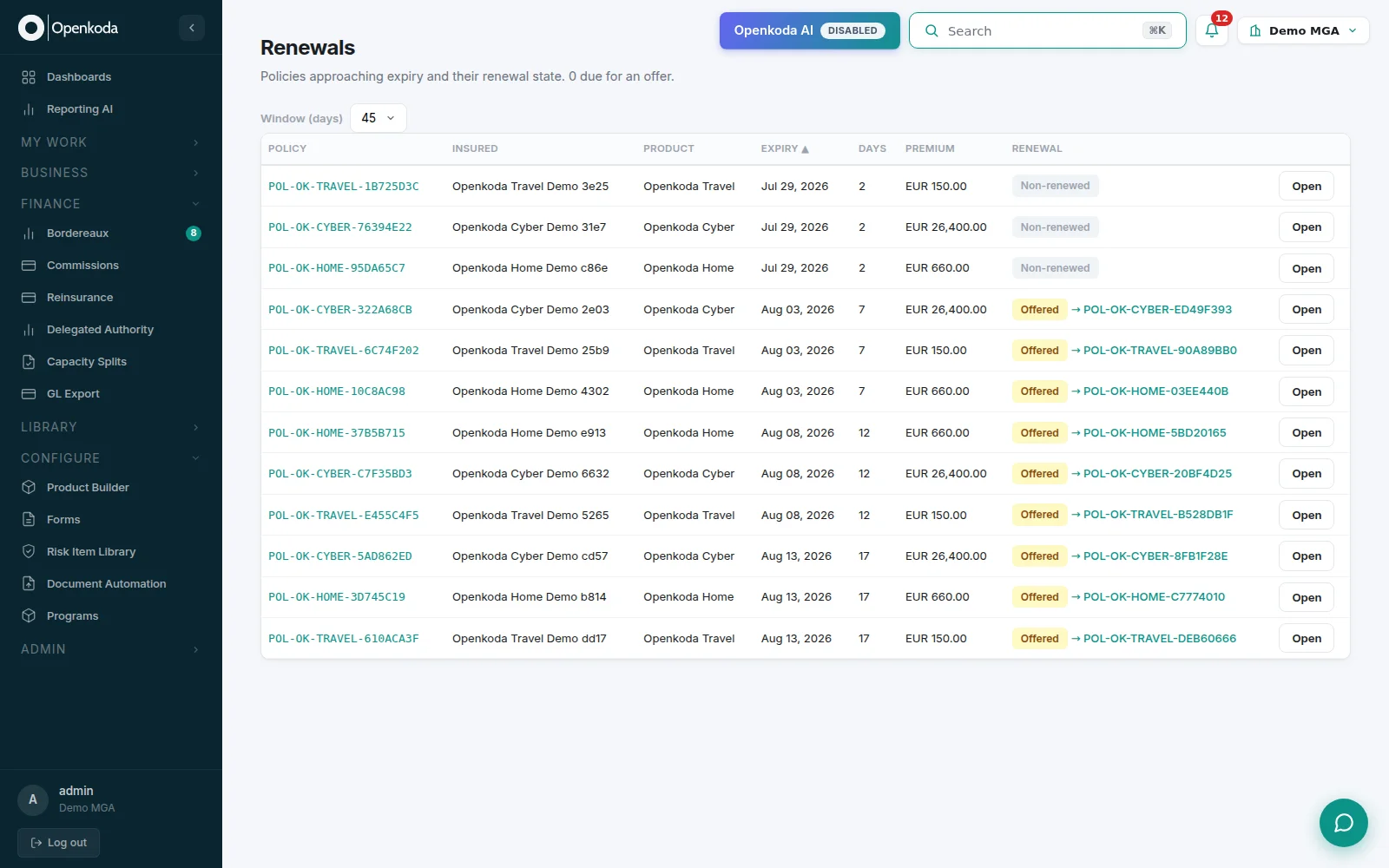
Where a broker holds delegated authority, the same platform runs full policy administration: issuing, endorsing and renewing directly, with bordereaux for the carrier. That is the main reason to choose it over an agency system: a brokerage that grows into an MGA does not have to change platforms. Product changes are drafted in plain English by the AI Product Builder and applied only after a person approves them.
Stratoflow is the implementation partner: Core Travel Insurance went from contract to a live platform on Openkoda in eight weeks (case study).
Best for
Brokers and MGAs that hold or plan delegated authority, and agencies that want one configurable platform rather than an agency system plus separate rating and policy tools.
Applied Epic
Applied Epic is a cloud agency management system for mid-size and enterprise independent agencies, with P&C and benefits business in one browser-based system, insurance accounting, quoting and submissions, and carrier connectivity through Ivans. Applied says 7 of the 10 largest agencies have standardized on it. Pricing is not published.
Best for
Mid-size and large US independent agencies writing P&C and benefits that want deep carrier connectivity in one system.
AgencyBloc AMS+
AMS+ is an agency management system and CRM for health, life, senior and group benefits agencies, sold with Commissions+, Engage+ and Quote+ in the AgencyBloc Plus Suite. Radius, the broker CRM that appeared on many older lists, has been folded into AMS+ since joining AgencyBloc. Pricing is on request.
Best for
Health, Medicare, life and benefits agencies, and the uplines (GAs, IMOs, FMOs) that manage downline agents.
Momentum AMS
Momentum AMS is the agency management system formerly known as NowCerts. It downloads policy updates from more than 300 carrier databases (Momentum's count), lets clients issue their own certificates, and tracks agency and agent commissions. Pricing is published: from $119 a month for one user and $54 for each additional seat, with no contract.
Best for
Small and mid-size US independent agencies, P&C in particular, that want a known price and a quick start.
Zoho CRM
Zoho CRM is a general sales CRM with AI agents built in; Zoho reports more than 300,000 businesses using it. It has no insurance data model, so policies, carriers and commissions have to be modelled as custom modules or kept in a separate agency system.
Best for
Agencies that already run an AMS and want a configurable sales pipeline beside it.
Insureio
Insureio is an insurance CRM for sales and marketing automation, built around lead management and application fulfilment. Its one-page application quotes more than 40 carriers for term and permanent life, long-term care, disability and annuities.
Best for
Life and annuity agents who sell by phone and email and want quoting and marketing in one tool.
Freshsales
Freshsales is Freshworks' sales CRM, with plans that Freshworks advertises from $9. Like Zoho, it is not built for insurance, so it works as a lead and pipeline tool rather than a record of the book.
Best for
Small agencies that need a low-cost pipeline before they need an agency system.
Key features to look for in insurance broker software
Feature lists from vendors look alike. The features that change an account handler's day are fewer:
- One client record with policies, claims, documents and correspondence, so anyone can answer a client call.
- Submissions captured once and sent to several markets, instead of retyped into each carrier portal.
- Carrier downloads or connectivity for the carriers you place with most.
- Renewals and follow-ups generated as tracked tasks, not calendar reminders.
- Commission tracking that compares what each carrier owes with what arrived.
- Document generation for quotes, certificates and cover notes from client data.
- A client portal and an API, so routine requests and other systems do not need re-keying.
Benefits of using insurance broker software
Faster admin is the benefit every vendor promises. The returns that change the economics of a brokerage are less obvious, and they decide whether the software pays for itself.
Renewals stop depending on someone's memory
When renewals, chasers and follow-ups are generated as tasks with an owner and a date, retention stops depending on which account handler remembers an account. A manager can see the next ninety days of renewals in one queue and move work before a policy lapses.
Missed commission becomes visible
Carriers pay commission on their own schedules and in their own formats. A system that records what each carrier owes against what arrived, split by producer, turns month-end reconciliation into a short list of exceptions, and an underpaid statement shows up while it can still be queried.
The book of business becomes an asset you hold
When policies, documents and conversations sit in carrier portals and personal inboxes, the agency's most valuable asset is scattered across systems it does not control. One client record makes the book something you can value, sell or hand to a new producer, and it stays when a producer leaves.
Placement gets faster without another hire
Capturing risk details once and sending them to several markets removes the retyping that fills an account handler's week. With hiring the top challenge independent agencies report in 2026 (see the statistics below), hours given back to experienced staff are easier to find than a new person.
A defensible record for E&O questions
An errors-and-omissions complaint turns on what the client was offered, what they declined and what they were told. When every email, call note and coverage decision sits on the client record, the agency can show what happened instead of reconstructing it from memory.
Clients handle the routine themselves
A client portal lets policyholders download documents, issue certificates and notify a claim without a phone call. The routine requests stop arriving as emails to re-key, and the team's time goes to placement and advice.
Implementation, integration and support
Most broker software projects stall on data, not on features. Before go-live, decide which client and policy history moves across, clean duplicates once rather than migrating them, and run the old and new systems side by side for at least one renewal cycle on a sample of accounts.
Integration decides how much retyping disappears: carrier downloads, the accounting system, email, e-signature and payments. Ask each vendor which of your systems it connects to out of the box and which need its API, and who builds and maintains those connections. Post-launch, the questions are who handles support tickets, how upgrades arrive, and whether your team can change forms and workflows without a vendor project.
Pricing considerations
Broker software is priced in three ways: per seat (Momentum AMS publishes $119 a month for one user plus $54 for each additional seat), quote on request (Applied Epic and AgencyBloc), and flat platform plans (Openkoda publishes its plans on openkoda.com). General CRMs such as Freshsales and Zoho start lower but leave the insurance data model to you.
Compare the whole stack over three to five years: seats as the team grows, the add-ons that are separate products (quoting, commissions, portals, automation), implementation and data migration, and the cost of the integrations you need.
Insurance broker software statistics for 2026
The independent agency channel is adopting AI faster than it is writing rules for it. The 2026 Agency Universe Study by the Big “I” and Future One (1,376 respondents) counts about 37,000 independent agencies in the US and finds 46% using AI, up from 15% in 2024. Finding and screening job candidates is the most-cited challenge, at 45%.
The Big “I” Agents Council for Technology's 2026 Tech Trends Report shows how shallow most of that use still is: 8% of agencies have AI integrated into daily workflows, and 55% have no written AI policy. Broker software that keeps AI suggestions behind human approval and an audit trail gives an agency those controls without writing them from scratch.
How to choose insurance broker software
- Start from your business model: placing only, or writing under delegated authority now or within a few years.
- Ask each vendor to show one submission going to three markets, and count the retyping.
- Check connectivity for the ten carriers you place with most, not the vendor's headline count.
- Ask who owns the data, in what format you can export it, and what leaving costs.
- Price the whole stack: seats, add-ons, portal, implementation and integrations.
- Call a reference agency of your size and lines of business.
If your brokerage is moving towards delegated authority, or you want one platform for placement and policy administration, our insurance team implements Openkoda and integrates the systems around it.